The stock market keeps changing its favourites. In one phase, established companies lead because investors prefer stability. In another, fast-growing mid-sized businesses move ahead as confidence returns. A fund that can adapt to these shifts may appear attractive, but a fixed allocation can also prevent emotional or poorly timed decisions.
This is the main difference between flexi cap funds and large & mid cap funds. A flexi cap fund gives the fund manager freedom to invest across companies of different sizes. A large & mid cap fund must maintain meaningful exposure to both large and mid cap companies.
Both can support long-term wealth creation, but they offer different combinations of flexibility, growth and risk. The better choice depends on how much control you want, how long you can stay invested and how you react when markets fall.
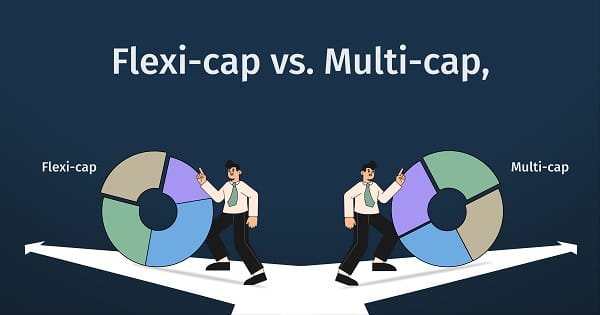
What Is a Flexi Cap Fund?
A flexi cap fund is an equity mutual fund that can invest across large cap, mid cap and small cap companies.
Under SEBI’s current scheme categorisation rules, a flexi cap fund must invest at least 65% of its total assets in equity and equity-related instruments. However, it does not have to maintain a fixed minimum investment in any particular market-cap segment.
This gives the fund manager considerable freedom. The portfolio may hold more large cap companies when stability or attractive valuations are preferred. The manager can increase mid cap or small cap exposure when better growth opportunities appear.
However, “flexi cap” does not mean that the fund will always be equally divided among large, mid and small companies. Some schemes may remain heavily invested in large caps for long periods.
What Is a Large & Mid Cap Fund?
A large & mid cap fund invests mainly in established large companies and growing mid-sized businesses.
According to SEBI’s categorisation framework, this category must invest at least 35% of its total assets in large cap companies and at least 35% in mid cap companies. The remaining portion can be managed according to the scheme’s stated strategy and regulatory limits.
This structure creates a more predictable portfolio. Investors know that the scheme will always maintain substantial exposure to both segments.
Large cap holdings may provide relative stability, while mid cap holdings can increase long-term growth potential. At the same time, compulsory mid cap exposure can make the fund more volatile during market corrections.
Flexi Cap vs Large & Mid Cap Fund: Major Differences
1. Market-Cap Allocation
A flexi cap fund has no compulsory allocation to large, mid or small cap companies. Its manager can change the portfolio according to market conditions and available opportunities.
A large & mid cap fund must maintain at least 35% each in large and mid cap stocks. It cannot significantly reduce mid cap exposure simply because that segment has become volatile or expensive.
Therefore, flexi cap funds offer freedom, while large & mid cap funds offer a defined allocation structure.
2. Risk and Volatility
Both categories are equity funds and can produce negative returns during weak markets. Equity schemes generally seek long-term growth but can remain volatile over shorter periods.
The risk of a flexi cap fund depends on its actual portfolio. A scheme holding mostly large cap stocks may experience comparatively lower volatility. Another scheme with substantial mid and small cap exposure may be considerably more aggressive.
Large & mid cap funds carry built-in mid cap exposure. They may therefore experience sharper fluctuations than large-cap-heavy flexi cap schemes.
3. Growth Potential
Flexi cap funds can search for growth opportunities across the market. A capable manager may identify attractive businesses among large, mid or small companies.
Large & mid cap funds receive regular exposure to mid-sized businesses, many of which may have greater room to expand than established market leaders. This can support long-term growth but also increases uncertainty.
Neither category is guaranteed to deliver higher returns. Performance depends on company selection, valuations, market conditions, expenses and fund management.
4. Fund Manager Flexibility
Fund manager decisions have a particularly important role in flexi cap funds. The manager must decide not only which companies to buy but also how much to allocate to each market-cap segment.
This flexibility can help when market leadership changes. However, incorrect allocation decisions may also affect returns.
A large & mid cap manager works within a more defined framework. The scheme cannot abandon either of its two main market segments, making its broad investment style easier to understand.
5. Portfolio Predictability
Large & mid cap funds are comparatively predictable. Investors can expect meaningful exposure to large and mid-sized companies throughout the investment period.
A flexi cap portfolio may change considerably. A scheme that is largely invested in big companies today may increase its mid or small cap allocation later.
Investors in flexi cap funds should therefore review the portfolio periodically rather than judging the scheme only by its name.
Who Should Choose a Flexi Cap Fund?
A flexi cap fund may be suitable for investors who:
- Want one diversified equity scheme
- Prefer the manager to decide market-cap allocation
- Want flexibility during changing market conditions
- Have an investment horizon of at least five to seven years
- Do not want compulsory high mid cap exposure
- Need a possible core holding for their equity portfolio
Flexi cap funds may be convenient for beginners because one scheme can provide exposure to different types of companies. However, the actual risk depends on the fund’s portfolio and strategy.
Who Should Choose a Large & Mid Cap Fund?
A large & mid cap fund may suit investors who:
- Want permanent exposure to both large and mid cap companies
- Seek stronger growth potential than a large-cap-focused portfolio
- Have an investment horizon of seven years or longer
- Can tolerate moderate to high volatility
- Do not want to select separate large and mid cap funds
- Can continue investing during market corrections
This category may be more suitable for moderately aggressive investors who want large cap stability combined with meaningful mid cap participation.
Can You Invest in Both?
Yes, but holding both is not always necessary.
A flexi cap fund may already own many of the large and mid cap stocks present in a large & mid cap fund. Combining them without checking their portfolios can create duplication rather than real diversification.
Holding both may make sense when the flexi cap fund is large-cap-oriented and the large & mid cap fund is being used to increase dedicated mid cap exposure.
Before investing, compare their major holdings, market-cap allocation and sector concentration.
Which Is Better?
A flexi cap fund may be better for investors who value adaptability, simplicity and freedom for the fund manager. It can change its market-cap allocation as opportunities and valuations change.
A large & mid cap fund may be better for investors who specifically want a fixed combination of established companies and growing mid-sized businesses.
For beginners or investors seeking one core equity fund, a well-managed flexi cap fund may be the more convenient option. For investors willing to accept higher volatility in exchange for compulsory mid cap exposure, a large & mid cap fund may be more suitable.
The decision should not be based only on the previous year’s returns. Compare performance across both rising and falling markets.
Frequently Asked Questions
Q1. Can a flexi cap fund invest entirely in large cap stocks?
A: It can maintain a very high large cap allocation because there is no fixed minimum for mid or small caps. However, its overall portfolio must follow the scheme’s stated investment objective and regulatory requirements.
Q2. Is a large & mid cap fund safer than a pure mid cap fund?
A: It may be comparatively less volatile because at least 35% is invested in large cap companies. However, substantial mid cap exposure means it can still experience sharp market fluctuations.
Q3. Which category is better for a monthly SIP?
A: Both can be used for a long-term SIP. Flexi cap funds may offer a more adaptable core investment, while large & mid cap funds suit investors who deliberately want meaningful mid cap exposure.
Q4. Should I switch when my fund underperforms for one year?
A: One year is generally too short to judge an equity fund. Review its benchmark comparison, portfolio quality, manager changes and performance across several market phases before switching.
Q5. How often should I review these funds?
A: A review once or twice a year is usually enough. Daily or monthly monitoring may encourage unnecessary decisions based on short-term market movements.